Every standards-based system looks a little different, but they should all have a few things in common. First, there need to be standards that drive curriculum, instruction, assessment, and reporting. There are many different approaches to the types of standards schools choose, the grain-size they use for instructing or reporting, and their philosophy about skills and content, but all agree that the destinations for learning must be clearly articulated. Second, there needs to be an intentional assessment system that determines where students are in relation to the targets at any given time; this system includes both formative and summative assessment practices. Third, all standards-based classes develop instruction in response to assessment data; in other words, we assess to find out what we need to do next to help all of our students progress towards or beyond our standards. This means that differentiated instruction is a necessary component of class. Finally, all standards-based classes should be grading, tracking, and reporting based on their standards--not based on points or percentages or behaviors.
We have worked hard over the past ten years to develop a standards-based system that works in our context. These faculty scales, and the examples that follow, show A way, not THE way. The work on this page comes from hundreds of teachers (many from the CVSD district, and many from without) who have collaborated and experimented and revised and shared their work so that others don't have to start from scratch. Please feel free to use whatever feels helpful, and to share your own work as well, so we can create a much more comprehensive set of examples.
We have worked hard over the past ten years to develop a standards-based system that works in our context. These faculty scales, and the examples that follow, show A way, not THE way. The work on this page comes from hundreds of teachers (many from the CVSD district, and many from without) who have collaborated and experimented and revised and shared their work so that others don't have to start from scratch. Please feel free to use whatever feels helpful, and to share your own work as well, so we can create a much more comprehensive set of examples.
Faculty Scales:
We worked with students, teachers, and administrators over years to develop a set of faculty scales that defines what standards-based learning looks like. We strongly suggest developing your own set of these scales (and you are free to use any/all of what we have if our descriptions of the learning match your needs, your beliefs, and your context), so that you have a common understanding among teachers of your own learning goals. Just like your targets/scales for students, these should regularly be revisited and revised as you gain a clearer understanding of your context and needs. Here is a complete list of the scales. They can be used to self-assess, guide the development of professional development, and to monitor school-wide growth. Below, we have broken them into 4 sections and provided some examples to help make sense of each scale. You can find further explanation and practical how-tos for each scale in our book.
Articulate Desired Results
K-U-Ds, Targets, Scales, & Collaboration with Special Educators
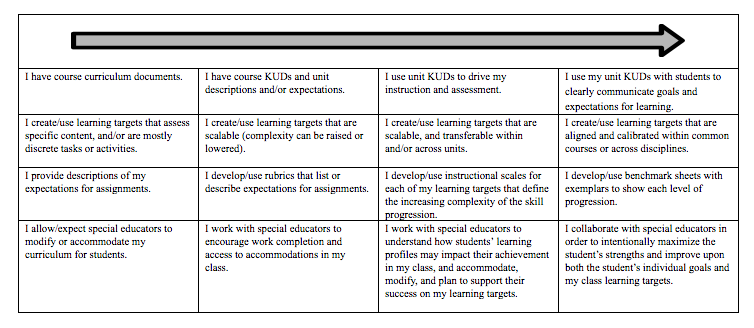
Examples: Here is a selection of examples of KUDs, Scales, Benchmark Sheets, and other resources. These have been created by teachers and are always in the process of revision based on student work and ongoing calibration.
|
High School
Intro to Art KUD Principles of Business KUD and Scales Latin 1 and KUD French 2 KUD Spanish 3 Scales AP Chem KUD Biology KUD and Scales Env Science KUD and Scales Humanities 10 scales 9th Grade Humanities KUD US History Scales AP Literature Scales and KUD Algebra KUD Algebra 2 KUD and Scales AP Calculus KUD and Scales Calculus KUD |
Benchmark sheet examples:
Integrated Bio: Reasoning (HS) Integrated Bio: Modeling (HS) Thesis Writing (HS) Using Evidence (HS) Developing Models (MS) Making a Claim (MS) Other Related Resources KUD and Scale Template Scale Template Transferable Skill Scales Modification vs Accommodation in a Standards-Based Class Backed out Humanities (HS) scales |
Develop Targeted Assessment
Summative, Formative, and Practice
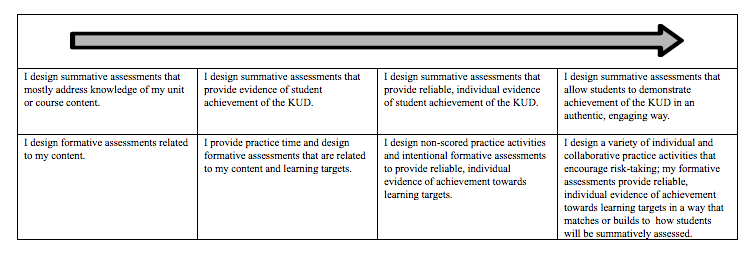
We will continue to add resources here, so check back. For now, take a look at an assessment professional development plan that helps teachers understand the shifting role of assessment in a standards-based classroom.
Assessment PD Plan
Task Sheets: a structure for practice, formative, and summative assessments
Claim Task Sheet and Formative
Formative for Craft and Structure
Modeling Energy Flow Formative
Evaluation Task Sheet
Homework in a Standards-Based Classroom
Assessment PD Plan
Task Sheets: a structure for practice, formative, and summative assessments
Claim Task Sheet and Formative
Formative for Craft and Structure
Modeling Energy Flow Formative
Evaluation Task Sheet
Homework in a Standards-Based Classroom
Design Effective Instruction
Direct and Differentiated
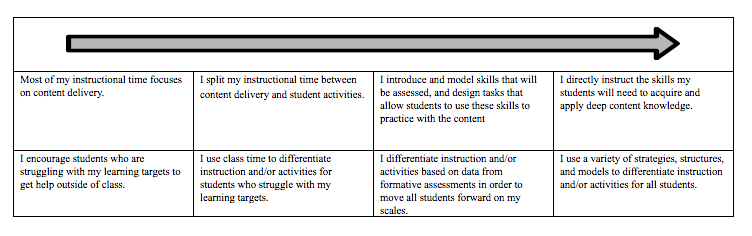
Keep checking back for more specific resources, but here is a strategy we have used for years to plan for differentiation based on data from formative assessments. We have filled out a sample template, but there is a blank at the end as well!
Differentiated Instruction Template
Sample DI Lesson: Middle Level Presentation Skills
Coin Rolling Demonstration: How to use a scale to instruct
Differentiated Instruction Template
Sample DI Lesson: Middle Level Presentation Skills
Coin Rolling Demonstration: How to use a scale to instruct
Monitor and Communicate Learning
Gradebook and Communication
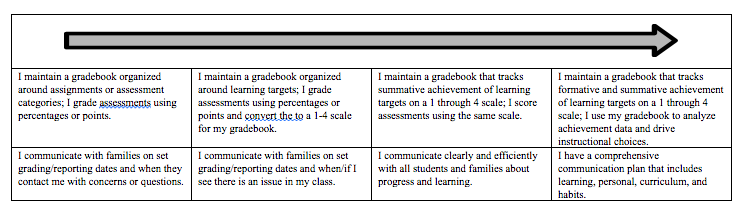
Communication Chart Template: Sample filled out with blank template included
Sample SB Report: JumpRope
Sample Draft Transcript (not in use)
Link to Mastery Transcript Consortium
Sample SB Report: JumpRope
Sample Draft Transcript (not in use)
Link to Mastery Transcript Consortium